Transitioning from high school to college can be hard for some students. Then the stress of academics, finding a community and being involved in extracurriculars that will help their future puts more stress on students.
So how is this transition and high stress period different for students who have lost a parent?
“Right after the student loses their parent there is a falter in school work,” Central Michigan University Social Work Professor Myrna McNitt said, “but after a few weeks or months the student goes back to their pre-parent death academic ability.”
McNitt has not only studied and worked with children affected by parent deaths, but she has personal experience. Her nephew, who is 19, lost his mother two years ago and in living with McNitt.
McNitt said that students become emotionally frozen. They will go to class, but they won’t be able to critically think.
Even though this is serious, McNitt said that the number one thing that happens to students who have lost a parent is not an academic plunge, but more of a social component.
“A student immediately becomes closer to their family or support system. You will see the child/teen close themselves off to people that are not their support systems and hold tight to a small group of people,” McNitt said.
Central Michigan University senior Abby Nelson, 22, was interviewed about her mother’s death.
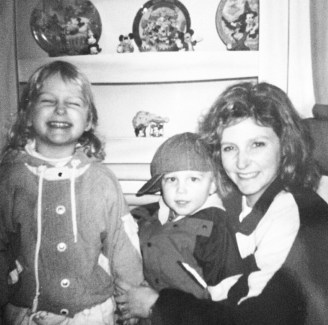
Abby Nelson’s mother, Amy Nelson, passed away suddenly from a heart attack. Pictured above is Abby, her younger brother, Jake, and her mother.
“Before my mom’s death I was ‘chatty Kathy’ according to my dad and would talk to any stranger, but then my mom died when I was four. From four to 12 I became very reserved. I clung to my dad and brother, but with anyone else I was very shy,” Nelson said, “Looking back, I believe the reason I became outgoing again when I was 12 was because my dad married again, so I had another positive mother figure in my life. I am a total extravert now, but I still have a hard time being vulnerable with others. I want to get to know them , but I won’t let them get to know me.”
McNitt said the parent/child dynamic can take a different route as well. The child can start feeling more responsibility, so the parent and child become equals viewing each other more as siblings.
Central Michigan University senior Madi Wolfe, 21, was interviewed about her father’s death by overdose.

Madi Wolfe’s father, Bobby Wolfe, passed away when Madi Wolfe was a freshman in high school.
“I was never super close to my mom. I think I just didn’t understand how she put up with my dad using drugs. I didn’t understand why she would put herself and her three daughters in harms way, because my dad could get violent when using drugs. My best friend, Macy, and her family ere much more of a protective support system than my actual family. Macy’s mom was was my role model and mother figure. When my dad died I stayed with Macy’s family a lot and had more of a sister relationship with my mom,” Wolfe said.
According to McNitt, the students may have grieved properly, but grief is not linear. The death of the parent can hit them out of nowhere. A sudden flashback, a holiday, or someone mentioning the parent can cause spark the grieving process again.





 Golfis Weekly